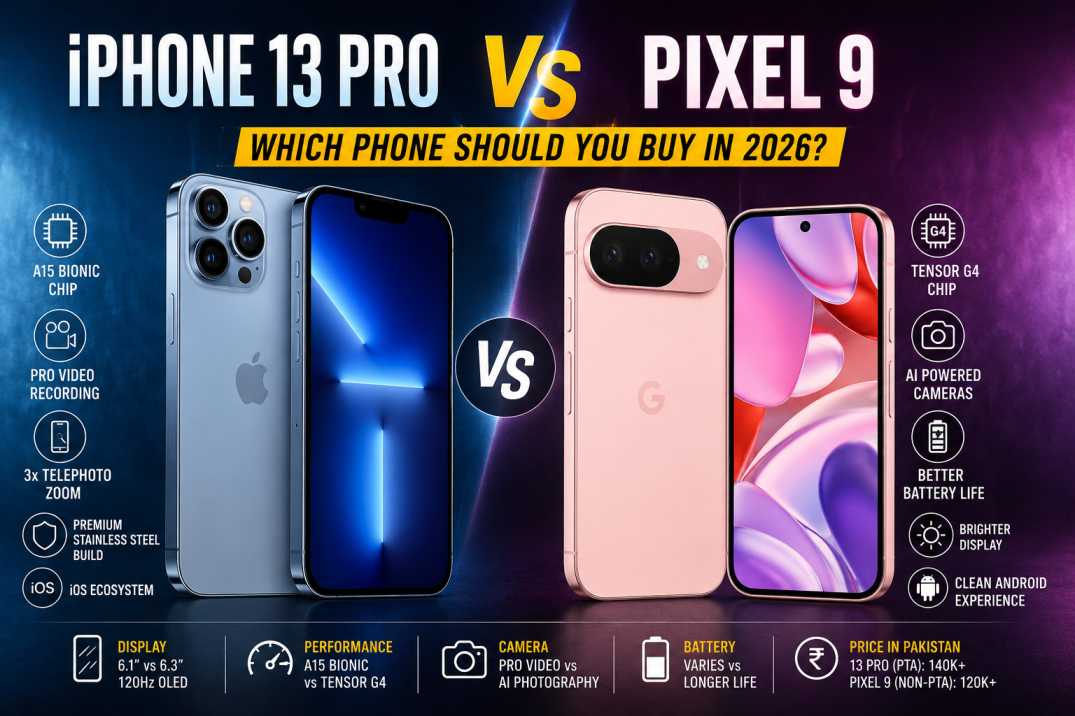
Buying a premium smartphone in 2026 is not as simple as choosing the newest model.
Many buyers now compare older flagship phones with newer Android devices because they often cost about the same.
One comparison that stands out is the iPhone 13 Pro versus the Google Pixel 9.
The iPhone 13 Pro is several years old, but it still offers flagship performance, premium build quality, and one of the best video cameras on any smartphone.
The Pixel 9 takes a different approach. It focuses on AI features, software, battery life, and best photography. It is also newer and easier to find in excellent condition.
Both phones have their strengths. The better choice depends on what you expect from your smartphone.
Price and Availability
In Pakistan, these phones often fall into a similar price range.
The iPhone 13 Pro is mostly available in the used market. Prices vary depending on battery health, condition, storage, and PTA status.
The Pixel 9 is newer. Many units are available in near new condition through importers and retailers.
This makes the comparison interesting. Buyers are choosing between a proven flagship and a modern Android phone with updated hardware.
If you're buying a used phone, always inspect it carefully before making a decision.
Design and Build Quality
Both phones feel premium.
The iPhone 13 Pro has a stainless steel frame with glass on the front and back. It feels solid and expensive in the hand.
The Pixel 9 uses an aluminum frame with Gorilla Glass protection. It is lighter and has rounded edges that make it comfortable to hold for long periods.
Both devices are rated IP68 for water and dust resistance.
However, keep one thing in mind.
A used phone may not offer the same level of water resistance if it has been repaired before. Always ask the seller whether the phone has ever been opened.
In terms of appearance, choosing between them comes down to personal preference.
The iPhone has Apple's familiar premium design.
The Pixel offers a cleaner and more modern look.
Display Comparison
Both smartphones have excellent displays.
The iPhone 13 Pro features a 6.1-inch Super Retina XDR OLED display with ProMotion technology. It supports a 120Hz refresh rate and delivers accurate colors.
The Pixel 9 has a slightly larger 6.3-inch OLED display. It also supports a 120Hz refresh rate.
Where the Pixel stands out is brightness.
Its display becomes much brighter outdoors, making it easier to use under direct sunlight.
Another advantage is its slimmer bezels.
The Pixel's screen feels more immersive because it avoids the large notch found on the iPhone 13 Pro.
That said, Apple's display still looks fantastic.
It offers excellent color accuracy, deep blacks, and smooth scrolling.
If you watch movies, browse social media, or play games, both displays perform exceptionally well.
The Pixel simply feels a little more modern.
Multimedia Experience
Both phones include stereo speakers.
Watching YouTube videos, Netflix, or listening to music is enjoyable on either device.
The iPhone produces deeper bass.
Its speakers sound richer and slightly louder.
The Pixel focuses more on clarity.
Vocals are easier to hear, especially when watching podcasts or dialogue-heavy content.
Neither phone disappoints here.
Most users will be happy with either choice.
Performance
Performance is one area where the iPhone still impresses.
The A15 Bionic chip continues to be one of Apple's strongest processors.
Apps open quickly.
Animations remain smooth.
Gaming performance is excellent.
Video editing is also fast.
Even though it is an older chipset, it still competes with many modern flagship processors.
The Pixel 9 is powered by Google's Tensor G4 processor.
Unlike Apple's chip, Tensor is designed with AI features in mind.
It performs very well during everyday tasks.
Browsing the web feels smooth.
Social media apps open instantly.
Multitasking is effortless.
Google's AI tools also improve voice recognition, translation, and image editing.
For most people, both phones feel fast.
The difference becomes noticeable only during demanding tasks.
If you play heavy games or edit large videos regularly, the iPhone 13 Pro still has an advantage.
Its graphics performance is stronger.
Many games are also better optimized for iOS.
Speed and Benchmark Results
Benchmarks are not everything.
Still, they help us understand how phones perform under pressure.
The iPhone 13 Pro consistently scores higher in many performance tests.
Applications launch slightly faster.
Video rendering takes less time.
Gaming frame rates remain more stable.
The Pixel 9 performs well too.
However, it prioritizes efficiency and AI rather than maximum raw performance.
During normal daily use, most people will not notice a major difference.
Both phones feel fast enough for work, entertainment, and multitasking.
The iPhone simply has more performance headroom for demanding users.
Battery Life
Battery life is one of the biggest differences between these two phones.
The Google Pixel 9 comes with a larger battery. It is also newer, which gives it an advantage in day-to-day use.
During normal usage, the Pixel lasts longer on a single charge.
It handles social media, video streaming, navigation, and web browsing without any trouble.
The iPhone 13 Pro still performs well, but battery life depends on one important factor.
Battery health.
Since most iPhone 13 Pro units are used, battery condition can vary significantly.
Some phones still have excellent battery health. Others may need a battery replacement.
Before buying a used iPhone, always check the Battery Health section in Settings.
A battery health above 85% is generally a good choice.
If it's below 80%, you should expect shorter battery life and may need a replacement soon.
Charging
Both phones support fast charging and wireless charging.
Neither is the fastest charging phone available today, but both are reliable for daily use.
A full charge takes roughly the same amount of time under normal conditions.
If battery backup is your priority, the Pixel 9 has the advantage.
Camera Comparison
This is where the competition becomes much more interesting.
Both smartphones take excellent photos.
However, they produce very different results.
The Pixel 9 focuses on computational photography.
Google's image processing delivers vibrant colors, balanced HDR, and impressive detail.
Photos often look ready to post on social media without any editing.
Portrait mode is also excellent.
Edge detection is accurate, and background blur looks natural.
The iPhone 13 Pro takes a different approach.
Its photos are more natural.
Colors are slightly softer.
Some people prefer this realistic look, while others enjoy the Pixel's punchier images.
Neither approach is wrong.
It simply depends on your personal preference.
Rear Cameras
The hardware is also different.
The iPhone 13 Pro includes:
Wide camera
Ultra-wide camera
3x telephoto camera
The dedicated telephoto lens gives Apple an advantage when zooming.
Images remain sharp even when using optical zoom.
The Pixel 9 features:
50MP main camera
48MP ultra-wide camera
Although Google's software produces impressive digital zoom, it cannot fully replace a dedicated telephoto lens.
If you regularly photograph distant subjects, the iPhone performs better.
Selfie Camera
Both phones capture detailed selfies.
The Pixel usually delivers brighter images with stronger HDR.
The iPhone produces more natural-looking skin tones.
In low light, Google's image processing often preserves more detail.
Apple, however, keeps colors more consistent across different lighting conditions.
For most users, both front cameras are excellent.
Video Recording
Apple continues to lead when it comes to video.
The iPhone 13 Pro offers outstanding stabilization.
Autofocus is fast.
Exposure changes smoothly.
Colors remain consistent throughout the recording.
It also includes Cinematic Mode, which adds depth effects to videos.
The Pixel 9 records excellent videos too.
Its HDR performance is often better, especially in difficult lighting.
However, Apple's overall video quality still feels more polished.
If you're a content creator or regularly shoot videos for YouTube, Instagram, or TikTok, the iPhone remains the safer choice.
Low Light Photography
Night photography has improved significantly on both phones.
The Pixel 9 generally captures brighter images with better dynamic range.
It handles shadows very well and keeps more detail in darker areas.
The iPhone also performs well in low light.
Its images usually appear more natural, although they can look slightly darker than those from the Pixel.
For still photography at night, the Pixel has a slight advantage.
Software Experience
Choosing between iOS and Android is often a personal decision.
If you already use Apple products, the iPhone fits perfectly into the ecosystem.
Features like AirDrop, FaceTime, iCloud, and Apple Watch integration work seamlessly together.
The Pixel offers a clean Android experience without unnecessary software.
Google also includes useful AI features such as:
Magic Editor
Circle to Search
Live Translate
Call Screening
AI-powered voice typing
If you enjoy Google's services, the Pixel feels incredibly smart and easy to use.
Gaming
Gaming performance still favors the iPhone.
The A15 Bionic handles demanding games with ease.
Frame rates remain stable.
Loading times are quick.
Games are also well optimized for iOS.
The Pixel 9 can play modern games without difficulty.
However, it focuses more on efficiency than maximum graphics performance.
Casual gamers will enjoy both phones.
Competitive gamers may prefer the iPhone.
Which Phone Should You Buy?
Choose the iPhone 13 Pro if you want:
Better video recording
Stronger gaming performance
Optical telephoto zoom
Apple's ecosystem
Premium stainless steel build
Choose the Google Pixel 9 if you want:
Longer battery life
Brighter display
Better HDR photography
AI-powered software features
A newer device with modern hardware
Final Verdict
Both phones are excellent choices in 2026.
The iPhone 13 Pro proves that a well-built flagship can remain competitive for years.
It still offers excellent performance, premium build quality, and some of the best smartphone video recording available.
The Pixel 9 feels more modern. It has a brighter display, better battery life, impressive AI features, and outstanding computational photography.
If photography, battery life, and a clean Android experience matter most, the Pixel 9 is the better option.
If your priorities are gaming, video recording, and Apple's ecosystem, the iPhone 13 Pro is still one of the best used flagship smartphones you can buy.
There is no universal winner.
The better phone depends on how you use it every day.
Instead of focusing only on specifications, think about your priorities, your budget, and the features you'll actually use.
That approach will help you make the right choice and get the best value for your money.
Compare Smartphone Specs Instantly
Confused which flagship device is perfect for your needs? Use our automated, side-by-side spec comparison system to check benchmark hardware, battery capacities, and pricing models.
Start ComparingThanks for reading!
Join our community for the latest mobile tech news and expert smartphone comparisons.