For years, one question has followed almost every discussion about Pakistan's telecom industry:
When will 5G finally arrive?
That question is no longer hypothetical.
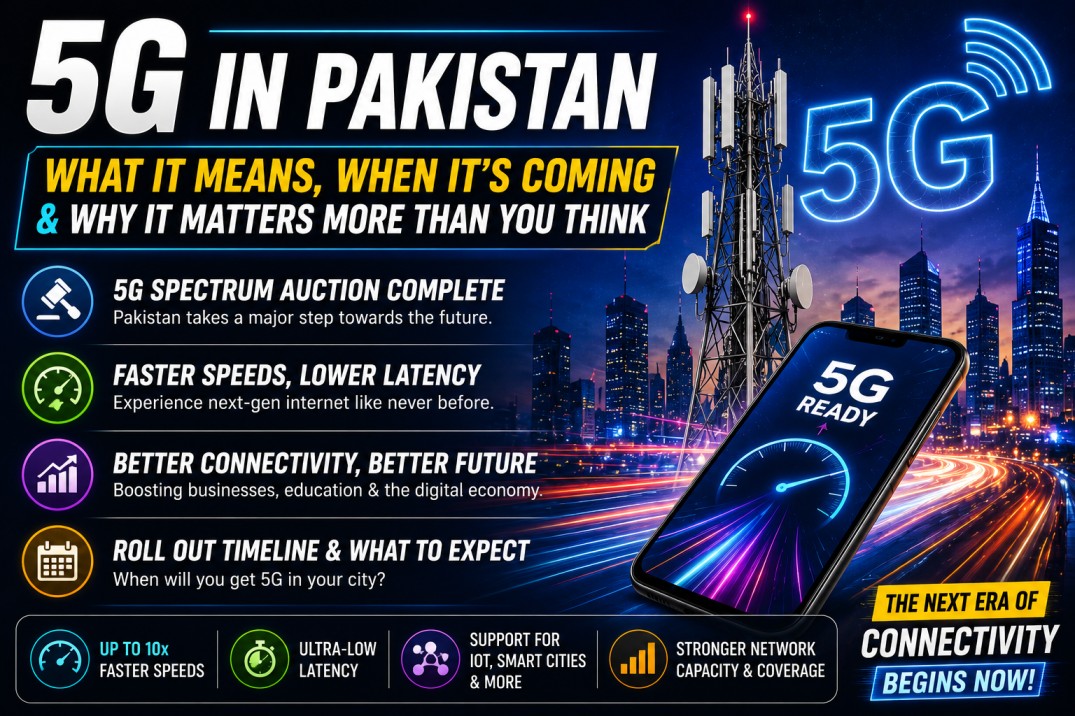
Pakistan has officially completed its 5G spectrum auction, marking one of the biggest developments in the country's telecom sector in recent years. While many people are focusing on download speeds and faster internet, the real story is much bigger than that.
5G is not simply an upgrade from 4G.
It represents a major shift in how digital infrastructure works, how businesses operate, and how millions of Pakistanis will connect to the internet over the next decade.
The auction itself is complete. The next challenge is turning that spectrum into a functioning nationwide network.
Why Pakistan Took So Long to Reach 5G
Whenever 5G is discussed, many people compare Pakistan to countries that launched the technology years ago.
On the surface, that comparison seems fair.
However, building a 5G network requires far more than simply switching on a new tower.
Network operators need access to radio spectrum, which acts as the foundation of wireless communication. Without sufficient spectrum, even the best telecom company cannot deliver consistent service.
This has been one of Pakistan's biggest challenges for years.
For a long time, local telecom operators were working with significantly less spectrum than many neighboring countries. As mobile internet usage increased, networks became crowded. The result was something most Pakistanis are already familiar with:
- Slow internet speeds
- Dropped calls
- Network congestion
- Inconsistent connectivity
Many users blamed operators directly, but the reality was often more complicated. Infrastructure limitations played a major role.
The recent spectrum auction is important because it directly addresses part of that problem.
What Happened in Pakistan's 5G Spectrum Auction?
The auction is being viewed as a major milestone for Pakistan's telecom industry.
Several frequency bands were made available, including:
- 700 MHz
- 2300 MHz
- 2600 MHz
- 3500 MHz
These frequencies are not all equal.
Lower-frequency bands typically offer better coverage and stronger indoor penetration. Higher-frequency bands provide greater capacity and faster speeds but usually cover shorter distances.
This is why telecom operators often need a mix of spectrum bands rather than relying on a single frequency.
According to the auction results, major operators including Jazz, Ufone, and Zong participated actively and secured spectrum allocations that will support future 5G deployment.
The significance of this goes beyond marketing.
More spectrum gives operators additional capacity to manage growing data demand. Even users who never connect to a 5G network may eventually benefit from improvements to overall network performance.
Will 5G Actually Make Internet Faster?
Yes, but speed is only part of the story.
Whenever 5G is mentioned, people immediately think about downloading movies in seconds or installing massive games instantly.
Those benefits are real.
However, focusing only on speed misses the bigger picture.
Most users in Pakistan currently experience mobile internet speeds that vary significantly depending on location, network congestion, and time of day.
In many areas, users are satisfied if they consistently receive 10 to 20 Mbps.
With improved spectrum availability and future 5G deployment, speeds could increase significantly. Industry expectations suggest many users may eventually see speeds far beyond what is common today.
But the real advantage is consistency.
A stable 50 Mbps connection is often more valuable than an unstable 150 Mbps connection.
For businesses, students, remote workers, and content creators, reliability is just as important as raw speed.
The Hidden Benefits of 5G
This is where the conversation becomes more interesting.
Many people think 5G exists purely to make YouTube videos load faster.
In reality, faster internet is only one piece of the puzzle.
Better connectivity can affect nearly every part of the digital economy.
Consider how much of modern life now depends on internet access:
- Remote work
- Online education
- Cloud computing
- Artificial intelligence services
- E-commerce platforms
- Digital payments
- Telemedicine
- Content creation
All of these industries benefit from stronger and more reliable networks.
This is why governments around the world view telecom infrastructure as an economic investment rather than simply a consumer service.
When internet quality improves, productivity often improves as well.
What About Gaming and Streaming?
This is the area where many consumers will notice changes first.
Online gaming continues to grow rapidly in Pakistan. Competitive mobile games such as PUBG Mobile, Call of Duty Mobile, and Free Fire all benefit from lower latency.
Latency refers to the delay between sending and receiving information across a network.
Even if your internet speed is fast, high latency can still create lag.
One of the biggest advantages of 5G is its ability to reduce latency significantly compared to older technologies.
For gamers, that could translate into smoother online experiences.
Streaming services could also benefit.
Higher-quality video streams, faster loading times, and more reliable connections all become easier when network capacity increases.
When Will Ordinary Users Get 5G?
This is probably the most important question.
The auction may be complete, but that does not mean users will see a 5G signal on their phones tomorrow.
Building a nationwide network takes time.
Telecom operators still need to:
- Upgrade infrastructure
- Install equipment
- Optimize networks
- Conduct testing
- Expand coverage areas
Initial rollout efforts are expected to focus on major cities first.
Large urban centers generally receive new technologies before smaller towns and rural regions.
That approach is common worldwide because operators can reach more users while recovering infrastructure investments more quickly.
For many Pakistanis, widespread access will likely be a gradual process rather than an overnight transformation.
Will You Need a New Phone?
Possibly.
Not every smartphone currently in use supports 5G connectivity.
Many budget and older devices remain limited to 4G networks.
Before expecting 5G access, users should verify whether their phone includes 5G support.
Fortunately, this is becoming less of a problem.
Most modern midrange and flagship smartphones now include 5G compatibility as a standard feature.
Brands such as Samsung, Xiaomi, Infinix, Tecno, Vivo, Oppo, and Honor already offer numerous 5G-capable models in Pakistan.
The Bigger Challenge: Execution
The auction was an important first step.
However, auctions alone do not improve user experience.
Execution does.
The next phase will determine whether Pakistan fully benefits from its spectrum investment.
Network operators must deploy infrastructure efficiently and expand coverage in a way that delivers real improvements for consumers.
History shows that successful telecom projects are not measured by announcements. They are measured by what users experience every day.
If rollout delays occur or infrastructure investments slow down, many of the expected benefits could take longer to reach consumers.
This is why the coming months may be even more important than the auction itself.
Final Thoughts
Pakistan's move toward 5G is one of the most important developments in the country's digital infrastructure journey.
While many headlines focus on faster downloads and impressive speed tests, the bigger story is about capacity, reliability, and long-term economic growth.
The additional spectrum gives telecom operators room to improve network quality, reduce congestion, and prepare for future demand.
For consumers, that could eventually mean faster internet, smoother streaming, better gaming experiences, and more reliable connectivity.
For businesses and the broader economy, the impact could be even larger.
The technology is finally moving from discussion to deployment.
Now the focus shifts to rollout, execution, and whether Pakistan can turn this opportunity into meaningful improvements for millions of internet users across the country.
Compare Smartphone Specs Instantly
Confused which flagship device is perfect for your needs? Use our automated, side-by-side spec comparison system to check benchmark hardware, battery capacities, and pricing models.
Start ComparingThanks for reading!
Join our community for the latest mobile tech news and expert smartphone comparisons.