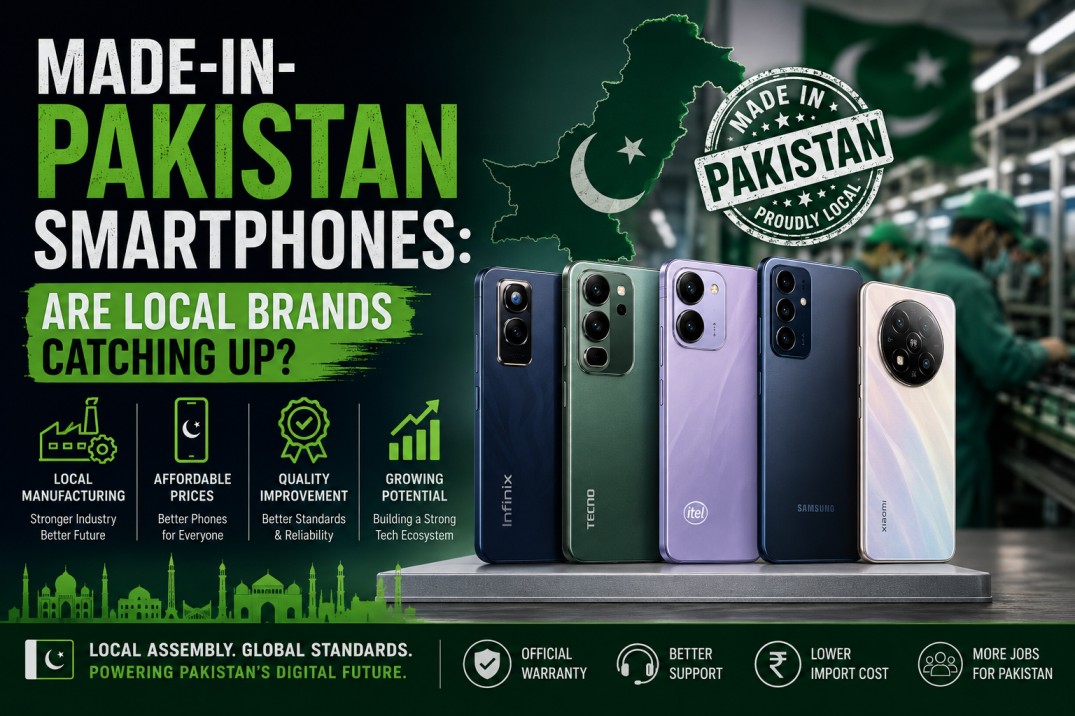
Pakistan’s smartphone market used to depend almost entirely on imported phones.
That has started changing over the past few years.
Today, millions of phones are assembled locally inside Pakistan through partnerships with Chinese brands and local manufacturing plants. The government calls it progress toward a stronger tech industry. Brands call it localization. Buyers mostly just want cheaper phones with fewer PTA headaches.
But an important question still remains in 2026:
Are locally assembled smartphones in Pakistan actually improving, or are they still just imported devices with “Made in Pakistan” labels on the box?
The answer is more complicated than most marketing campaigns suggest.
Most smartphones labeled “Made in Pakistan” are not fully manufactured here.
They are usually assembled locally from imported components.
That includes:
Pakistan’s factories mainly handle:
Local assembly reduces import pressure, creates jobs, and lowers costs for brands.
The issue is that many consumers hear “Made in Pakistan” and imagine local engineering or Pakistani-designed phones.
That is not really happening yet.
Pakistan spends billions on imports every year. Smartphones became a major part of that problem.
The government introduced the Mobile Device Manufacturing Policy to encourage local assembly and reduce dependence on imported finished devices. (moitt.gov.pk)
That policy changed the market fast.
According to the Pakistan Telecommunication Authority (PTA), locally assembled mobile phones now dominate Pakistan’s smartphone shipments. (pta.gov.pk)
Several companies opened or expanded assembly plants, including:
Some of Pakistan’s best-selling “local” phones are actually assembled by international Chinese brands operating through local partnerships.
Infinix, Tecno, and itel
These brands probably benefited the most from Pakistan’s localization push.
All three belong to Transsion Holdings and aggressively targeted budget and midrange buyers.
Their phones now dominate many offline markets in Pakistan because they offer:
And honestly, they understood Pakistani buyers better than many global companies did.
Most users here prioritize:
This matters because Samsung’s biggest weakness in Pakistan used to be pricing.
Chinese competitors were undercutting Samsung aggressively in lower segments.
Local assembly helped Samsung reduce costs and compete more effectively in the budget and midrange categories.
Still, Samsung’s locally assembled phones are mostly entry-level and midrange models.
Premium Galaxy flagships are still heavily import-dependent.
Xiaomi especially benefited because Pakistani buyers already trusted the brand for value-focused hardware.
But localization alone does not automatically guarantee success.
The bigger issue is software optimization and after-sales service.
And this is where some brands still struggle badly.
Practically, not always.
Local assembly reduces certain taxes and import costs. That should lower prices.
But Pakistan’s currency instability, import restrictions, and component dependency still create pricing problems.
Sometimes locally assembled phones launch at prices that still feel surprisingly high.
This is especially obvious in the midrange segment.
For example:
A locally assembled phone may still cost close to an imported older flagship with better cameras and performance.
That creates a difficult comparison for buyers.
Brands often advertise local assembly as a value advantage, but users mostly judge phones by specs and pricing, not factory location.
A few years ago, locally assembled phones in Pakistan had a weak reputation.
Common complaints included:
Modern locally assembled phones from brands like Infinix, Tecno, Samsung, and Xiaomi feel far more polished than older generations.
Build quality has improved significantly.
Some devices now offer:
Still, software quality remains inconsistent.
Hardware has improved faster than software refinement.
That has started changing over the past few years.
Today, millions of phones are assembled locally inside Pakistan through partnerships with Chinese brands and local manufacturing plants. The government calls it progress toward a stronger tech industry. Brands call it localization. Buyers mostly just want cheaper phones with fewer PTA headaches.
But an important question still remains in 2026:
Are locally assembled smartphones in Pakistan actually improving, or are they still just imported devices with “Made in Pakistan” labels on the box?
The answer is more complicated than most marketing campaigns suggest.
What Does “Made in Pakistan” Actually Mean?
This is the first thing buyers need to understand.Most smartphones labeled “Made in Pakistan” are not fully manufactured here.
They are usually assembled locally from imported components.
That includes:
- Displays
- Chipsets
- Camera sensors
- Batteries
- Motherboards
Pakistan’s factories mainly handle:
- Final assembly
- Packaging
- Software flashing
- Quality testing
Local assembly reduces import pressure, creates jobs, and lowers costs for brands.
The issue is that many consumers hear “Made in Pakistan” and imagine local engineering or Pakistani-designed phones.
That is not really happening yet.
Why Pakistan Started Pushing Local Smartphone Assembly
The main reason was economic pressure.Pakistan spends billions on imports every year. Smartphones became a major part of that problem.
The government introduced the Mobile Device Manufacturing Policy to encourage local assembly and reduce dependence on imported finished devices. (moitt.gov.pk)
That policy changed the market fast.
According to the Pakistan Telecommunication Authority (PTA), locally assembled mobile phones now dominate Pakistan’s smartphone shipments. (pta.gov.pk)
Several companies opened or expanded assembly plants, including:
- Infinix
- Tecno
- itel
- Samsung
- Xiaomi
- Vivo
- Oppo
- Nokia partnerships
Which Brands Are Actually Manufacturing in Pakistan?
This part surprises many people.Some of Pakistan’s best-selling “local” phones are actually assembled by international Chinese brands operating through local partnerships.
Infinix, Tecno, and itel
These brands probably benefited the most from Pakistan’s localization push.
All three belong to Transsion Holdings and aggressively targeted budget and midrange buyers.
Their phones now dominate many offline markets in Pakistan because they offer:
- Big batteries
- Fast charging
- High refresh-rate displays
- Aggressive pricing
And honestly, they understood Pakistani buyers better than many global companies did.
Most users here prioritize:
- Battery life
- Big displays
- Social media cameras
- Fast charging
- Price
Samsung Pakistan
Samsung also expanded local assembly operations in Pakistan through partnerships. (samsung.com)This matters because Samsung’s biggest weakness in Pakistan used to be pricing.
Chinese competitors were undercutting Samsung aggressively in lower segments.
Local assembly helped Samsung reduce costs and compete more effectively in the budget and midrange categories.
Still, Samsung’s locally assembled phones are mostly entry-level and midrange models.
Premium Galaxy flagships are still heavily import-dependent.
Xiaomi, Vivo, and Oppo
These brands also expanded assembly presence in Pakistan through local manufacturing facilities and partnerships.Xiaomi especially benefited because Pakistani buyers already trusted the brand for value-focused hardware.
But localization alone does not automatically guarantee success.
The bigger issue is software optimization and after-sales service.
And this is where some brands still struggle badly.
Are Locally Assembled Phones Actually Cheaper?
Technically yes.Practically, not always.
Local assembly reduces certain taxes and import costs. That should lower prices.
But Pakistan’s currency instability, import restrictions, and component dependency still create pricing problems.
Sometimes locally assembled phones launch at prices that still feel surprisingly high.
This is especially obvious in the midrange segment.
For example:
A locally assembled phone may still cost close to an imported older flagship with better cameras and performance.
That creates a difficult comparison for buyers.
Brands often advertise local assembly as a value advantage, but users mostly judge phones by specs and pricing, not factory location.
Quality Control: Have Local Phones Improved?
Yes, but inconsistently.A few years ago, locally assembled phones in Pakistan had a weak reputation.
Common complaints included:
- Poor finishing
- Heating issues
- Weak quality control
- Software bugs
- Cheap accessories
Modern locally assembled phones from brands like Infinix, Tecno, Samsung, and Xiaomi feel far more polished than older generations.
Build quality has improved significantly.
Some devices now offer:
- IP ratings
- AMOLED displays
- Stereo speakers
- Fast charging above 70W
- High refresh-rate screens
Still, software quality remains inconsistent.
Hardware has improved faster than software refinement.
The Biggest Weakness: Software Experience
This is where many local-market-focused brands still lag behind.The hardware race is easy to advertise.
Software polish is harder.
Brands like Tecno and Infinix now offer impressive specs for the price, but their software still feels overloaded with:
- Bloatware
- Spam notifications
- Duplicate apps
- Aggressive RAM management
- Random ads in system apps
But the difference becomes obvious when users switch from Samsung or Apple devices.
This is probably the biggest area where local-market-focused brands still need improvement.
After-Sales Support Still Needs Work
This is another major issue.Pakistan’s smartphone service ecosystem remains inconsistent.
Some official service centers are excellent.
Others struggle with:
- Delayed repairs
- Parts shortages
- Warranty confusion
- Poor communication
This becomes a bigger problem as phones become more expensive.
Buyers spending Rs. 80,000 to Rs. 150,000 now expect premium support experiences.
Many brands are still not fully delivering that.
Are Pakistani Brands Creating Original Innovation?
Not really. At least not yet.Most “local” smartphone success in Pakistan still depends heavily on Chinese ecosystems and imported technology.
Pakistan currently excels more at assembly than innovation.
There are very few globally recognized Pakistani smartphone brands developing original chipsets, operating systems, or hardware ecosystems.
That sounds harsh, but it is realistic.
The country is still in an early-stage manufacturing phase.
That said, assembly itself still matters.
Countries like India and Vietnam also started with assembly-focused growth before scaling deeper into electronics manufacturing.
Pakistan could eventually follow a similar path if policies remain stable.
The PTA Factor Changed Everything
PTA taxes completely reshaped Pakistan’s smartphone market.Imported phones became dramatically more expensive after taxes and DIRBS registration costs increased.
That gave locally assembled phones a massive advantage.
Suddenly, buyers started comparing:
Official local phones with warranty
vs
Imported PTA-unapproved devices
For many users, local devices became the safer option financially.
This is one reason why midrange brands exploded in popularity after 2022.
People who once bought imported flagship phones shifted toward officially assembled devices instead.
Are Local Brands Catching Up to Samsung and Apple?
In hardware value, yes.In overall ecosystem quality, not even close yet.
That distinction matters.
Brands like Infinix and Tecno now offer:
- Faster charging
- Bigger batteries
- Higher refresh rates
- More aggressive pricing
But premium smartphone experiences are not just about specs anymore.
Software consistency, camera processing, ecosystem integration, resale value, and long-term updates matter too.
That is where Samsung and Apple still dominate.
Many Pakistani buyers eventually realize this after the honeymoon phase ends.
A phone with amazing specs can still feel frustrating if the software experience is weak.
The Real Future Depends on One Thing
Pakistan has already proven it can assemble smartphones at scale.The next challenge is deeper technological independence.
That means:
- Better local engineering
- Stronger software development
- Local supply chains
- Better repair infrastructure
- Higher manufacturing standards
But it is still mostly assembling someone else’s innovation.
That is progress.
Just not the final stage yet.
So Is “Made in Pakistan” Actually a Good Thing?
Overall, yes.Local assembly has helped:
- Reduce dependence on imports
- Create jobs
- Expand affordable smartphone access
- Improve official warranty availability
- Increase competition
But buyers should avoid blindly trusting marketing labels
“Made in Pakistan” does not automatically mean premium quality.
And imported does not automatically mean better either.
The smarter approach is to judge phones individually.
Some locally assembled phones in 2026 are genuinely excellent value.
Others still rely heavily on flashy specifications to hide weaker software and long-term support.
SponsoredAdChoices (i)
Compare Smartphone Specs Instantly
Confused which flagship device is perfect for your needs? Use our automated, side-by-side spec comparison system to check benchmark hardware, battery capacities, and pricing models.
Start ComparingThanks for reading!
Join our community for the latest mobile tech news and expert smartphone comparisons.