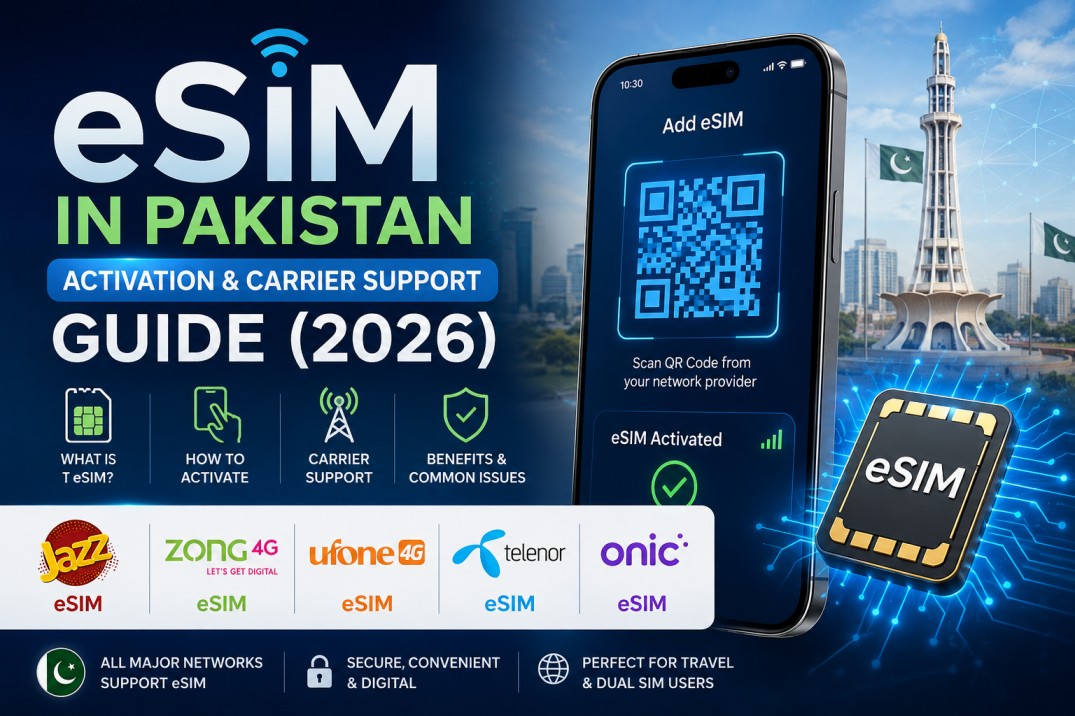
eSIM support in Pakistan has improved fast over the past two years.
eSim used to feel like a premium feature for iPhones but now it is available on many Android phones as well.
Jazz, Zong, Ufone, Telenor, and newer digital networks like Onic now support eSIM in some form.
Still, the process is not as simple as carriers claim.
Some networks require physical visits. Others charge surprisingly high activation fees. Compatibility problems are also common, especially with PTA-unapproved phones.
This guide explains how eSIM works in Pakistan, which carriers support it in 2026, how activation actually works, and what buyers should know before switching from a physical SIM.
Instead of inserting a plastic SIM card, users activate a mobile network through software. Usually, this happens by scanning a QR code provided by the carrier.
The biggest advantage is convenience.
You can switch networks without replacing SIM cards. You can also use two numbers on one phone more easily.
That matters because many modern phones now ship with limited physical SIM slots.
Apple already removed physical SIM trays completely in some international iPhone models. Android brands are slowly moving in the same direction.
Popular eSIM-compatible phones include:
Many imported phones in Pakistan come from the UAE or China. Some Chinese variants remove eSIM support entirely.
That creates confusion because buyers assume every flagship model includes it.
Before switching, users should check the phone’s exact model number. That matters more than the marketing name.
Jazz eSIM
Jazz was among the earliest Pakistani networks to push eSIM support seriously.
Its activation process is relatively polished compared to competitors. Both prepaid and postpaid users can access eSIM services.
Jazz also handles dual-SIM functionality well on supported iPhones and Samsung devices.
Still, Jazz stores can be inconsistent. Some franchises understand eSIM setup properly. Others still treat it like a niche feature.
That inconsistency remains a major issue in Pakistan’s telecom retail market.
Zong eSIM
Zong offers eSIM for both new numbers and SIM replacement requests. Users typically need to visit a customer service center for biometric verification.
Zong’s biggest advantage remains data performance.
In many urban areas, Zong delivers much stronger 4G speeds than other telecom operators in Pakistan. That makes it attractive for users that rely heavily on mobile data.
The downside is customer support.
Zong’s digital experience still feels less refined than Jazz in some areas.
Ufone eSIM
Ufone entered the eSIM market later than competitors.
Its activation fee also feels unusually high for a feature that is mostly software-based. Ufone currently charges around Rs. 2,000 for eSIM conversion or activation.
That pricing feels difficult to justify when some global carriers provide eSIM activation for free.
Still, Ufone performs reasonably well in major cities and works fine for average users.
Telenor eSIM
Telenor expanded eSIM support nationwide more recently. The company supports both prepaid and postpaid activation through service centers and retailers.
eSim used to feel like a premium feature for iPhones but now it is available on many Android phones as well.
Jazz, Zong, Ufone, Telenor, and newer digital networks like Onic now support eSIM in some form.
Still, the process is not as simple as carriers claim.
Some networks require physical visits. Others charge surprisingly high activation fees. Compatibility problems are also common, especially with PTA-unapproved phones.
This guide explains how eSIM works in Pakistan, which carriers support it in 2026, how activation actually works, and what buyers should know before switching from a physical SIM.
What Is eSIM?
An eSIM is a digital SIM built directly into your phone.Instead of inserting a plastic SIM card, users activate a mobile network through software. Usually, this happens by scanning a QR code provided by the carrier.
The biggest advantage is convenience.
You can switch networks without replacing SIM cards. You can also use two numbers on one phone more easily.
That matters because many modern phones now ship with limited physical SIM slots.
Apple already removed physical SIM trays completely in some international iPhone models. Android brands are slowly moving in the same direction.
Which Phones Support eSIM in Pakistan?
Most flagship phones now support eSIM. Mid-range devices are starting to adopt it too.Popular eSIM-compatible phones include:
- iPhone 11 and newer
- Samsung Galaxy S23, S24, S25, and Ultra models
- Google Pixel devices
- Foldable Samsung phones
- Some Xiaomi and Huawei flagships
- Latest iPads and smartwatches
Many imported phones in Pakistan come from the UAE or China. Some Chinese variants remove eSIM support entirely.
That creates confusion because buyers assume every flagship model includes it.
Before switching, users should check the phone’s exact model number. That matters more than the marketing name.
Which Networks Support eSIM in Pakistan?
All important telecom operators now offer eSIM support in Pakistan. The experience is ofcourse very different across carriersJazz eSIM
Jazz was among the earliest Pakistani networks to push eSIM support seriously.
Its activation process is relatively polished compared to competitors. Both prepaid and postpaid users can access eSIM services.
Jazz also handles dual-SIM functionality well on supported iPhones and Samsung devices.
Still, Jazz stores can be inconsistent. Some franchises understand eSIM setup properly. Others still treat it like a niche feature.
That inconsistency remains a major issue in Pakistan’s telecom retail market.
Zong eSIM
Zong offers eSIM for both new numbers and SIM replacement requests. Users typically need to visit a customer service center for biometric verification.
Zong’s biggest advantage remains data performance.
In many urban areas, Zong delivers much stronger 4G speeds than other telecom operators in Pakistan. That makes it attractive for users that rely heavily on mobile data.
The downside is customer support.
Zong’s digital experience still feels less refined than Jazz in some areas.
Ufone eSIM
Ufone entered the eSIM market later than competitors.
Its activation fee also feels unusually high for a feature that is mostly software-based. Ufone currently charges around Rs. 2,000 for eSIM conversion or activation.
That pricing feels difficult to justify when some global carriers provide eSIM activation for free.
Still, Ufone performs reasonably well in major cities and works fine for average users.
Telenor eSIM
Telenor expanded eSIM support nationwide more recently. The company supports both prepaid and postpaid activation through service centers and retailers.
Telenor’s problem is no longer technology. It is coverage perception.
In many rural areas, users still trust Jazz or Zong more for network stability.
That affects adoption because eSIM users are usually premium smartphone buyers. Those buyers care heavily about reliable connectivity.
Onic eSIM
Onic is currently the most modern approach to eSIM in Pakistan.
The entire network is designed around digital onboarding. Users can activate plans through the app without dealing with physical stores in many cases.
That sounds basic globally, but in Pakistan’s telecom market, it actually feels ahead of the curve.
The challenge for Onic is long-term reliability. Traditional carriers still have stronger infrastructure and broader coverage.
How to Activate eSIM in Pakistan
The process depends on the carrier, but usually follows these steps:- Visit a carrier franchise or app
- Complete biometric verification
- Request eSIM activation
- Receive QR code
- Scan QR code through phone settings
- Restart device
- Activate network profile
On iPhone:
- Go to Settings
- Mobile Data
- Add eSIM
- Scan QR code
- Settings
- Connections
- SIM Manager
- Add eSIM
Many issues happen because carrier staff are not properly trained on eSIM setup.
Common eSIM Problems in Pakistan
PTA Approval IssuesThis is the biggest problem.
If your phone is not PTA approved, eSIM activation may fail completely. Some imported devices partially support networks but block certain features.
Many buyers discover this only after paying activation fees.
QR Code Expiry
Some carriers issue one-time QR codes that expire quickly.If activation fails during setup, users may need to revisit the franchise for a replacement code.
That feels unnecessarily outdated in 2026.
Weak Customer Support
eSIM is still treated like a premium feature by many service centers.Some staff members barely understand how it works.
That becomes frustrating when activation problems appear.
Is eSIM Better Than Physical SIM?
Mostly, yes.eSIM is more convenient and more secure. Physical SIM theft becomes harder because there is no removable card.
Travelers also benefit heavily. Users can install international data plans without changing their main Pakistani number.
Still, physical SIM cards remain easier for quick phone switching.
That matters in Pakistan because many users frequently swap devices or use secondary phones.
eSIM feels like the future, but Pakistan’s telecom ecosystem is still transitioning slowly.
Should You Switch to eSIM in 2026?
If your phone supports it, probably yes.The convenience alone makes it worthwhile.
But expectations should stay realistic.
Pakistan’s telecom industry still handles eSIM like an advanced feature instead of a normal standard. Activation quality depends heavily on the carrier and even the franchise location.
Right now, Jazz and Onic offer the smoothest overall experience.
Zong remains strong for mobile data users.
Ufone and Telenor work fine, but neither feels especially ahead in the eSIM race.
The technology itself is solid.
The ecosystem around it still needs improvement.
SponsoredAdChoices (i)
Compare Smartphone Specs Instantly
Confused which flagship device is perfect for your needs? Use our automated, side-by-side spec comparison system to check benchmark hardware, battery capacities, and pricing models.
Start ComparingThanks for reading!
Join our community for the latest mobile tech news and expert smartphone comparisons.